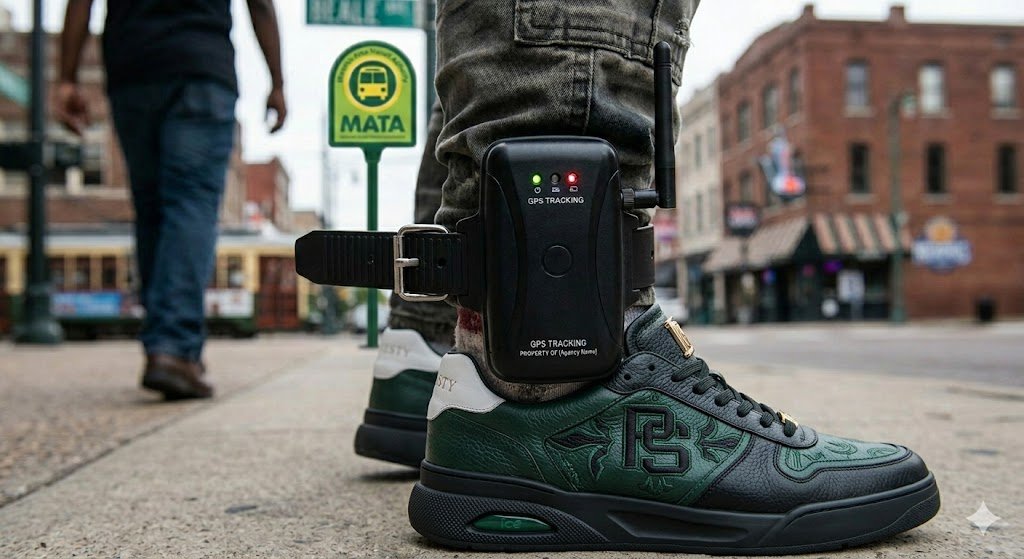
The case of Pooh Shiesty (Lontrell Williams Jr.) is a masterclass in how “old school” street logic often crashes head-first into “new school” surveillance technology. While the rapper was living his best life in the spotlight, a small, plastic device strapped to his leg was quietly whispering his every move to the federal government.
Here is the breakdown of how ankle monitors work, how the Feds used one to build a case against Pooh Shiesty, and why you can’t outrun a satellite.
1. The Tech: What Is an Ankle Monitor?
Think of an ankle monitor as a smartphone that you can’t turn off, can’t leave at home, and can’t silence. Most modern monitors, like the one Shiesty was wearing, use Active GPS Tracking.
How it’s Designed:
- The Hardware: It’s a tamper-resistant “bracelet” equipped with a GPS chip, a cellular transmitter, and a series of sensors.
- The “Breadcrumb” Trail: Every minute (or even every few seconds), the device pings a satellite to determine its exact latitude and longitude. It then sends that data via cellular networks to a central monitoring station.
- The Geo-Fence: Officers can draw “virtual boxes” on a map. If the wearer enters a “No-Go Zone” (like a victim’s house) or leaves a “Stay-In Zone” (like home during curfew), the device screams an alert to the authorities instantly.
2. The Pooh Shiesty Connection: The Dallas Studio Incident
According to federal investigators and reports from Made Life Ez, the rapper’s own “jewelry” became his biggest snitch.
In April 2026, new evidence surfaced regarding an incident at a Dallas recording studio. While Shiesty and his crew were allegedly involved in a confrontation/robbery, the Feds weren’t just relying on eyewitnesses or grainy CCTV. They had a forensic digital map.
How the Feds Used It:
- Time-Stamping: Investigators took the exact time of the crime and looked at Shiesty’s GPS logs.
- The “Smoking Gun” Location: The data didn’t just show he was “in Dallas”—it showed he was in the specific room of the studio at the exact moment the incident occurred.
- Pattern of Life: By looking at the days leading up to the event, they could prove he wasn’t there by accident; they could see his travel path, where he stayed, and who he was with.
3. Why He “Should Not Have Done That”
In the rap world, an ankle monitor is often seen as a badge of honor—a sign that you’re “really in the streets” but out on bond. However, from a legal perspective, it’s a suicide mission to commit a crime while wearing one for three main reasons:
- The “Non-Debatable” Evidence: You can argue that a witness is lying. You can argue that a photo is blurry. You cannot argue with a satellite. GPS data is considered “hard evidence” because it is objective and mathematically verified.
- Zero Privacy: When you agree to an ankle monitor to get out of jail, you effectively sign away your Fourth Amendment right to privacy regarding your location. The Feds don’t need a new warrant to check where you were yesterday; they already own the data.
- The “Aggravator”: Committing a crime while on bond (and wearing a monitor) usually leads to “Sentence Enhancements.” It tells the judge you have zero respect for the court’s leniency, which often results in a much heavier prison sentence.
4. How the Feds Play the “Long Game”
The FBI and federal prosecutors love ankle monitors because they allow for Data Correlation.
If a crime happens, the Feds can run a “Geofence Query.” They ask, “Which monitored individuals were within 50 feet of these coordinates at 2:00 PM?” If Pooh Shiesty’s ID pops up, the case is essentially closed before it even begins.
They also use Cell Tower Triangulation as a backup. If the GPS signal is weak (like inside a thick concrete studio), the device uses nearby cell towers to “triangulate” the position. There is almost nowhere to hide.
5. The Lesson: Tech vs. The Streets
The “Legend of Lontrell Williams Sr.” (Pooh’s father) and the Shiesty family history often involve stories of old-school grit, as detailed in the Lontrell Williams Sr. arrest history. But the game has changed.
The takeaway is simple: In the 1990s, you could “disappear” into the city. In 2026, the city is watching you through the very device you’re wearing to stay out of a cell. For Pooh Shiesty, the ankle monitor wasn’t just a fashion statement; it was a digital confession.
Pro Tip: If you’re wearing a device that talks to satellites, maybe don’t go where you’re not supposed to be. The satellites are always listening, and they don’t take bribes.
For more on the intersection of hip-hop and legal drama, check out the latest on the Pooh Shiesty investigation.






Leave a Reply